Thursday, April 12, 2012

Larry Page Just Dropped A Huge Hint That A Google Tablet Is Coming Soon - Business Insider

Larry Page Just Dropped A Huge Hint That A Google Tablet Is Coming Soon - Business Insider: "Larry Page strongly hinted that Google has plans for a cheaper tablet during the company's earnings call today.
When asked by an analyst about Google's tablet plans, Page noted cheaper tablets running Android have seen great success. (He specifically mentioned one that doesn't run a "full version of Android," e.g. Amazon's Kindle Fire.)
Page then said he thinks there will be a lot of success with budget tablets, saying "it's an area we're quite focused on."
There have been a lot of rumors lately that Google plans to release it's own tablet running a clean version of Android. The tablet will likely be sold by Google via a special online store.
The rumors also say the tablet will be a 7-inch device made by Asus and cost about $200, the same price as the Kindle Fire."

'via Blog this'

Boeing To Release A Super-Secure Android Smartphone Later This Year | TechCrunch

Boeing To Release A Super-Secure Android Smartphone Later This Year | TechCrunch:


As if producing commercial airliners, helicopters, and satellites didn’t keep Boeing busy enough, the company revealed earlier this week that they would soon be branching out into a slightly different market.National Defense Magazine reports that Boeing is currently working on an highly-secure Android-based smartphone of all things, and that it should see a release later this year.
Boeing President Roger Krone declined to go into specifics when it came to the device’s hardware or release date, though he did note the Boeing Phone (the company hasn’t officially decided on a name yet) is nearing the end of its development cycle. It seems as though the device has been in the works for a while so it’s a safe bet that the spec sheet won’t be the most competitive, and I wouldn’t expect to see anything newer than Froyo or Gingerbread running on it.
If you hadn’t already guessed, this isn’t the sort of device you’ll be able to pick up at your local mom-and-pop cell phone store. In developing their Android phone, Boeing kept an eye on big competitors in the secure communications market, who often price their proprietary devices in the five-figure range. Thanks in part to the inclusion of a free (not to mention robust) mobile operating system, Boeing plans to introduce their smartphone at a much lower price, which should please the procurement folks within the Defense Department and other security-conscious operations.
Cost apparently isn’t the only reason that Boeing opted to create an Android device — with Google’s OS accounting for over around 50% of the U.S. smartphone market, users are coming to expect more out of their work-issued devices. As Krone told National Defense Magazine’s Stew Magnuson, the Boeing Phone will give customers “what they are used to seeing [on consumer market smartphones] and give them the functionality from the security perspective.”
Boeing isnt the first company to surprise us with news of a security-conscious mobile device — Dell surprised us late last year when they announced that the their discontinued (and oft-maligned) Dell Streak 5 was the first Android device to be given the official seal of approval by the U.S. Department of Defense. Folks within the organization were apparently fond of the mini-slate’s design, though I have to wonder how well those things actually hold up in the field.

Google Announces A New Stock Structure So It Can Still Pay With Stock Without Losing Founder Control - Business Insider

Google Announces A New Stock Structure So It Can Still Pay With Stock Without Losing Founder Control - Business Insider:

Google just announced plans for a new stock structure, which effectively creates a 2-for-1 stock split.
Every shareholder will get a non-voting share of Google stock which will be listed on the NASDAQ.
Google will basically have two types of stocks trading on the NASDAQ. It will have an "A share" which is the stock with voting powers, and a "C share," which doesn't have voting powers.
Google is doing this so that its founders can maintain control over the company, while still paying out equity based compensation.
This was a much more common maneuver years ago. Warren Buffett's Berkshire Hathaway has a similar structure. In general, the "C shares" tend to trade at a discount to the "A shares."
The stock is up 1% on the news in after-hour trading.
Here's the explanation of the move:
Today we announced plans to create a new class of non-voting capital stock, which will be listed on NASDAQ. These shares will be distributed via a stock dividend to all existing stockholders: the owner of each existing share will receive one new share of the non-voting stock, giving investors twice the number of shares they had before. It’s effectively a two-for-one stock split—something many of our investors have long asked us for. These non-voting shares will be available for corporate uses, like equity-based employee compensation, that might otherwise dilute our governance structure.
We recognize that some people, particularly those who opposed this structure at the start, won’t support this change—and we understand that other companies have been very successful with more traditional governance models. But after careful consideration with our board of directors, we have decided that maintaining this founder-led approach is in the best interests of Google, our shareholders and our users. Having the flexibility to use stock without diluting our structure will help ensure we are set up for success for decades to come.


Read more: http://www.businessinsider.com/google-announces-new-stock-structure-2012-4#ixzz1rrkdN1Xx

Wednesday, April 11, 2012

Nokia Launches Its First Windows-Based NFC Phone, the 610, With Orange | TechCrunch

Nokia Launches Its First Windows-Based NFC Phone, the 610, With Orange | TechCrunch:


Nokia has been weathering a series of glitches around the launch of its Lumia range of Windows Phone devices — the most recent of which saw the company issue credits to users affected by data connection issues on the new Lumia 900. It is pressing on with new devices, though, and we have confirmed with sources close to the company that it will be launching its first NFC-enabled Windows Phone in Europe, a version of the Lumia 610, at 1pm UK time today — along with a partnership with a European operator, France Telecom’s Orange, to launch the device “across Europe.”
Update: Orange and Nokia have now officially announced the 610. The details are noted as below. The pair say that the device has been certified for contactless payments both with MasterCard PayPass technology, and with Visa’s mobile application for payments at the point of sale, Visa payWave, which means it will work when activated and used with merchants that have linked up with this technology.
Nokia first unveiled the phone accidentally via a video on YouTube, which it then made private. Before it did that, a copy of it was made by TheGadgetBuff and picked up by The Next Web, which also published a photo of a display noting a 2pm launch. We have confirmed with sources that the launch is taking place at 1pm UK time.
The source told us the device will be launching with an operator, and in the video (embedded below) Nokia’s lead program manager for NFC, Andrea Bociaccola, says that the operator is Orange. We have confirmed that the launch will be “across Europe” according to our well-placed source.  
It is not clear whether this launch is going to be in one of Orange’s market or several
 Orange has mobile operations throughout Europe, including the UK, as well as Africa and the Middle East.
Orange has made a big push into rolling out NFC in its home market of France, and more recently has also committed to services in the UK. In March the company said it had sold 500,000 NFC-enabled handsets in France — a mix of Samsung, Acer and BlackBerry devices. Rollouts of actual commercial services to use them more widely, however, have been slower in coming.
Today’s launch, it appears, was scheduled to take place in Monaco at the Global NFC Products, Applications & Services Congress, where Nokia’s VP of product marketing and smart devices, Ilari Nurmi; and Orange’s mobile contactless services director, Didier Durand, are scheduled to speak together at 2pm Monaco time. TechCrunch understands that may now be moved forward in light of the video leak.
Bociaccola demonstrates how the NFC can be used with (Nokia) speakers to manage music, and he notes that in future it can also be used for monetary transactions — although this doesn’t seem to be something that will be available at launch.
It will also be usable with Foursquare check-ins, judging by the video, as well as to interact with other social networks (eg ‘tap to follow us on Twitter’).
Nokia was one of the first handset makers to incorporate NFC into mobile phones. However, up to now NFC has not gained much critical mass among other handset makers, merchants and others that might utilize the technology (like other consumer electronics companies) — so Nokia hasn’t had much of an early mover advantage as a result.
On top of that, there have been a multitude of solutions rolled out that bypass NFC altogether (Square and PayPal’s Here being two notable examples). That raises the question of whether NFC really will be as central to mobile commerce and other kinds of mobile transactions as people once thought it would be.
However there are plenty of companies out there putting big stakes into NFC, including the big payment processors as well as Nokia competitors, and so it’s an important area to keep pursuing.
Nokia’s putting NFC into the 610 means also that Nokia is continuing to forge ahead and make sure that it’s bringing along some of its legacy innovation into the next stage of its strategy to remain relevant in the mobile world.

Facebook campaign ‘Strip for Likes’ breaks the rules | ZDNet

Facebook campaign ‘Strip for Likes’ breaks the rules | ZDNet:


Advertising agency Arnold Amsterdam today launched a Facebook marketing campaign for clothing brand Stüssy that is very controversial, to say the least. In fact, it’s actually not allowed, according to Facebook’s own rules. You can see the Facebook app which is featured in the above video here: Strip for Likes.
The firm found a model on Facebook, dressed her up in every piece of men’s clothing from Stüssy’s Spring/Summer 2012 line, and then had her strip off all the clothes as the Facebook Page gets more Likes. Facebook users can also invite their friends to the Page so they can Like the campaign as well.
Here’s how Arnold Amsterdam describes the campaign:
We always complain about brands that are begging for Likes. But “Strip for Likes” for Stüssy’s Facebook fanpage at least uses the mechanism in an original way. The more likes, the more clothes come off. What’s smart about it is that once you’ve liked the stripper, you’ll be inclined to come back and see what her status is. On top of that you’ll see a whole bunch of Stüssy clothes; she thus actually becomes a catwalk stripper. Nice, simple, and effective.
I’m not quite sure why Stüssy wants to associate its brand with a stripper. What is clearly directed at Stüssy’s male audience could easily alienate its female consumer base. Furthermore, Stüssy probably isn’t aware the campaign isn’t allowed on Facebook.
Under the Facebook Pages Terms, there’s a section called Promotions, which features these two points (the second one is almost exactly what is happening here):
  • You must not use Facebook features or functionality as a promotion’s registration or entry mechanism. For example, the act of liking a Page or checking in to a Place cannot automatically register or enter a promotion participant.
  • You must not use Facebook features or functionality, such as the Like button, as a voting mechanism for a promotion.
“As you can imagine the model must be suffocating under that many layers of clothing,” Colin Lamberton, Creative Arnold Amsterdam, said in a statement. “It is almost a public duty to free her out of this misery so we are expecting Facebook fans to help out here. Like and undress.”
“As a contemporary brand you need to be wherever your fans live, shop or play,” Sean Thompson, Head of Creativity of Arnold Amsterdam, said in a statement. “Facebook plays an integral part of their lives, Stussy AMS’ Facebook is therefore an important platform to engage with fans inform them or just share the fun.

Google's latest Chrome OS: You now have a desktop, but... | ZDNet

Google's latest Chrome OS: You now have a desktop, but... | ZDNet:

By  | April 11, 2012, 2:31am PDT
Summary: Google’s latest Chrome OS for developers looks a bit like Windows, Ubuntu and Mac OS X. Is that enough?
Google updated its Chrome OS and users of Chromebook are now free of a full browser window. It’s unclear whether the Chrome OS updates will make it more popular.
I downloaded the latest Chrome OS via Google’s developer channel. There’s a Samsung Chromebook that has been on my desk for a while. I started to use the Chromebook, but got this stuck in a sandbox feeling. After a while I resented the full browser window view. I felt trapped.
Google’s latest build of the Chrome OS changes that equation. There’s a dock bar (limited to the Chrome browser, search and apps) and you can resize the browser screen. In other words, Google’s Chrome OS looks a bit like Windows, Ubuntu and Mac OS X.
It’s obvious to me that Google is at least subliminally admitting that its first approach with the Chrome OS was just off. Now that the Chrome OS looks a little more conventional perhaps it’ll gain traction.
But I doubt it. In a nutshell, Google’s latest dev version of the Chrome OS does the following:
  • Takes your Chrome OS icons and puts them on an icon;
  • Gives you a limited doc bar;
  • And allows you to minimize the browser window.
Those changes give me a larger sandbox, but I still feel a bit trapped. I want the Chrome OS to do more. The app selection has improved on the Chrome OS, but Google is building a lot of that software to seed the ecosystem.
The end game for Chrome OS is a merger of sorts. Google is likely to take the Webtop it’s getting from Motorola Mobility, stir in Android, update the Chrome OS and slap it all together.
Today, Chrome OS is a fine experiment. But it’s an experiment that probably won’t entice you to buy a Chromebook just yet unless prices fall dramatically and you’re an enterprise clamoring for a Web terminal.
Kick off your day with ZDNet's daily e-mail newsletter. It's the freshest tech news and opinion, served hot. Get it.

PC shipments in Q1: Could have been much worse | ZDNet

PC shipments in Q1: Could have been much worse | ZDNet:


By  | April 11, 2012, 2:08pm PDT
Summary: HP is the top PC maker globally, but Lenovo is surging. In the U.S. standings, HP, Dell and Apple hold the top three spots.
PC shipments in the first quarter didn’t scorch any growth charts, but they did avoid a predicted decline.
According to Gartner data, PC shipments in the first quarter checked in at 89 million units, up 1.9 percent from a year ago. Gartner has projected a 1.2 percent decline. IDC data shows PC unit growth of 2.3 percent in the first quarter.
In other words, the PC patient has a pulse despite a tablet onslaught.
However, there are plenty of things to worry the PC industry. For starters, India and China growth wasn’t that great. Europe Middle East and Africa PC shipments were up 6.7 percent in the first quarter compared to a year ago. In the U.S., PC shipments were 15.5 million, down 3.5 percent from a year ago.
Globally, HP grabbed share with 17.2 percent of the market. HP has been able to secure hard drive supplies and that helped a good bit. Overall, the hard drive shortage didn’t hurt PC sales too much.
Lenovo delivered the most growth with 28 percent first quarter unit growth. Lenovo is now the No. 2 PC maker worldwide.
In the U.S. HP had 29 percent market share, followed by Dell and Apple.

Google+ rolls out new look - CNN.com

Google+ rolls out new look - CNN.com:


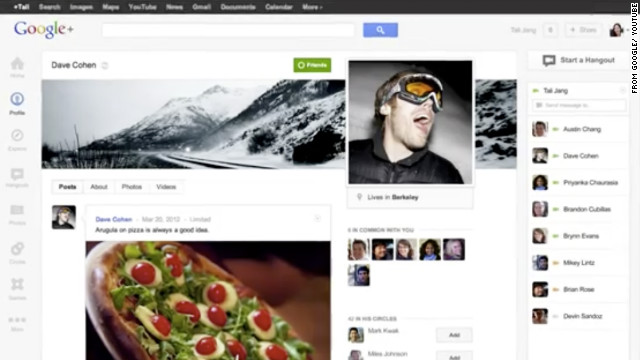
(Mashable) -- Google announced on Wednesday that it is rolling out a significant redesign for its social networking platform Google+, which will allow users to create a more customized experience on the site.
The company said it will introduce a variety of new features to the site in the next few days, from customizing apps and the navigation bar to more flexibility with profile pages and pictures. In addition, the update introduces a new Explore page that posts what's interesting and trending across the site.
Google also noted that the social network now boasts more than 170 million users since it's 2011 launch.
Google+ will now offer profile pages that will include bigger photos, a la Facebook's Timeline, and feature a chat list that puts friends front and center on your page. Another major update involves how users can navigate around the news stream. Instead of static icons at the top, there's a ribbon of apps on the left.
The ribbon allows users to drag apps up or down to create the order, hover over certain apps to reveal a set of quick actions and show or hide apps by moving them out of the section.
"Taken together, these powers make it easier to access your favorites, and to adjust your preferences over time," Google senior vice president Vic Gundotra wrote on Google's Official Blog. "We've also built the ribbon with the future in mind, giving us an obvious (and clutter-free) space for The Next Big Feature, and The Feature After That. So stay tuned."
A dedicated Hangouts page has also been added to the site, so people can have quick access to public and On Air video chat hangouts. This will allow Google+ users to meet new people and watch live broadcasts, as well as enter new rooms via a rotating billboard of Hangouts.
"It's still early days, and there's plenty left to do, but we're more excited than ever to build a seamless social experience, all across Google," Gundotra said.
What do you think of the redesign? Do you think Google+ will ever be able to compete with Facebook? Let us know in the comments.

Web tips for the newly unemployed - CNN.com

Web tips for the newly unemployed - CNN.com:

Editor's note: Brenna Ehrlich and Andrea Bartz are the sarcastic brains behind humor blog and book "Stuff Hipsters Hate." Got a question about etiquette in the digital world? Contact them atnetiquette@cnn.com.
(CNN) -- Raise your hand if someone you know was laid off in the last month. The odds are pretty good (meaning awful). Last week, the Bureau of Labor Statistics revealed that hiring slowed dramatically in March.
Although more people are being taken on than cut loose in the private sector as a whole, the public sector continues to hemorrhage jobs, and recently we've seen dismissals in everything from magazines to nursing homes.
You know the Web is critical to a thorough job search, but when you get the boot you must clomp around a trickier minefield than if you were simply seeking to switch jobs.
We talked to a few career experts about the wise digital moves for the newly unemployed. Tune in next week for part 2 of 2: How to survive beyond that first week of employment.
Let's say you haven't been fired just yet
(Social) network, (social) network, (social) network.
Yes, you should be schmoozing with contacts in real life, informational interviews are important, the whole nine yards. But you should also be strategically networking online, hooking up with new friends on Facebook, new professional peeps on LinkedIn, and new potentially interesting contacts on Twitter, Instagram and the like.
Spend a few minutes a week stoking cyber-relationships: liking posts, congratulating your contacts on promotions, and offering up clever commentary. Like IRL elbow-rubbing, it's only slimy if you're completely feigning interest in a Machiavellian scheme to eventually crush your competitors.
"You want to start taking advantage of social media networking opportunities prior to being laid off so you're not scrambling when you need a favor," says Nicole Williams, LinkedIn's connection director. In other words, it'll look a lot more suspect if you wait until after you're laid off to pipe up with the "remember me's."
Volunteer to write recommendations
"Start taking opportunities to help out other people," Williams suggests, "so you feel comfortable asking for their help when you need it."
You don't have to be creepy about it (There's just no way "YOU ARE SO GREAT! CAN I WRITE YOU A RECOMMENDATION?" will come across as normal), but let your co-workers and former interns know you're always happy to put in a good word. LinkedIn has a handy tool for posting recommendations right on people's resume-like profile pages, but even saying nice things about people on Twitter, Facebook or your blog can get you on their good side.
Right after you're canned
Don't bad-mouth the company.
We know, we know, we know: The boss is totally unfair and plays favorites, plus she makes tuna melts for lunch and leaves the break room reeking of fish, and your lazy co-workers take all the credit for your work.
Kindly gulp some air and keep all those thoughts to yourself.
"B----ing online about being laid off is not good reputation management and puts a negative spin on the job search that ensues," says Donna Flagg, founder of the consulting firm The Krysalis Group. "The world is smaller than ever now with these social networks. It's just not worth it."
Even seemingly protected Facebook statuses or tweets are far from private. Constrain the complaining to teary phone calls with Mom.
The days following the reaping
Update your LinkedIn profile, Google profile, etc.
No one's going to recommend you for an opening if they don't know you're job-searching. Put an end-date on your current position on LinkedIn, and drop the company name from your blogger profile. "At the end of the day, there's no sense lying about your employment status," Williams says.
Or don't.
...unless you think the benefits of strategically misleading outweigh the risks, of course, as does Steve Cohen, president and partner of the Labor Management Advisory Group and HR Solutions: On-Call.
"It is never a good idea to broadcast being laid off or out of work," he says. "For most people, what we do is who we are. If we are unemployed, then we are nobody."
His fire-and-brimstone words aren't unfounded: UCLA and State University of New York-Stony Brook researchers found that, all things being equal, unemployed job applicants are viewed as less competent, warm and hireable than employed folks -- whether they were fired, laid off or quit voluntarily.
Still, we have a hard time picturing someone getting through a job interview while simultaneously telling the truth and answering all those questions about your "current position." Evade at your own risk.
Ask for recommendations.
You get one week, a mere seven days, before everyone forgets about you. Strike while the iron's hot and ask newly former colleagues, their faces pinched with pity, to write you recommendations on your LinkedIn profile.
"Outline exactly what bullet points you'd like them to hit on so that it's easy for them to put it together," Williams suggests. "These recommendations verify the fact that you're a talented employee with a solid track record, and the layoff was just circumstantial."
And -- bonus! -- their guilt and simpering sympathy will translate into especially sentimental endorsements.
Get the word out in a positive way.
A histrionic broadcast along the lines of, "SOOOOOOOOO I JUST GOT LAID OFF TODAY! Welp" isn't exactly the most tactful way to let the world know you're on the market again.
"If you control the message and take on a tone of, 'It's your lucky day, I'm free to share my talent with you!' it reflects the fact that you expect to be in demand," Williams says. That can help deflect some of the furrowed brows and tacit assumptions that maybe, just maybe, you were "laid off," with flamboyant finger-quotes.
Target contacts who might actually be able to help you (Facebook friends, probably; the followers of your blog on minor characters in circa-1960s Marvel comics, definitely not) and sum up in a sentence or two the kind of position you seek and why you're an absolute catch for a company.
Then settle in, because if current data are any indication (which, inherently, they are), you'll be in this for the long haul.
Check back next Wednesday for our experts' tips on those long, dark months of job-seekery.

Tuesday, April 10, 2012

I.B.M. Aims to Sharply Simplify Corporate Data Center Technology - NYTimes.com

I.B.M. Aims to Sharply Simplify Corporate Data Center Technology - NYTimes.com:


Corporate data centers are the slowpoke laggards of information technology. But suppliers of hardware systems are working on new ways to speed things up.
Noah Berger for The New York Times
Steven A. Mills, I.B.M.'s senior vice president in charge of hardware and software.
Jon Simon/Feature Photo Service for IBM
The PureSystems technology, the product of a major investment put at $2 billion.
It can take up to six months, research shows, to get a new business application up and running, from buying the hardware to fine-tuning the software. An estimated 70 percent of corporate technology budgets is spent on installing, updating and maintaining current technology — keeping the digital lights on.
Although the problem has been developing for a long time, technology managers and analysts agree it is growing worse. That’s because the pace of technological change is accelerating and business users expect more services, faster. The difficulties, by all accounts, are worldwide.
“The current model is broken, it doesn’t scale,” said Sunil Bajpai, group general manager for the Center for Railway Information Systems, the technology arm of India’s state-owned railway system. “The demand for new applications and the demand for data are endless. We have to simplify.”
I.B.M. is bringing its answer to the marketplace on Wednesday — an effort that industry executives and analysts say is the most ambitious step yet to simplify and streamline data center technology. With this initiative, I.B.M. will sell bundles of server hardware and software packaged in simplified systems, with setup and maintenance automated by intelligent software. Tasks that now take days or weeks can be reduced to hours, the company claims.
The so-called expert integrated systems, known as PureSystems, are the product of a $2 billion investment in research and development and acquisitions over the last four years, I.B.M. says.
Other major suppliers — including Oracle, Hewlett-Packard, EMC, Cisco and Dell — are moving along the same path.
Without real progress in making data centers nimble and efficient, more corporate computing chores, analysts say, will be farmed out to the cloud — remote data centers managed by others, with programs delivered over the Internet. The major technology companies all have cloud offerings, but their mainstay business remains selling hardware and software to corporate customers.
Hardware suppliers like H.P., EMC and Cisco, analysts say, are getting together to sell server computers and storage and networking equipment in packages. But these companies, they say, lack the extensive software assets and expertise of Oracle, the database and business applications giant, which acquired Sun Microsystems, a maker of both hardware and software, in a $7 billion deal that was completed in 2010.
Oracle offers hardware and software packages, tailored for specific computing chores like database queries and data analytics, which carry the branding prefix “exa,” as in Exadata and Exalytics.
I.B.M. is taking a similar approach, but going further in terms of the variety of software options offered, including systems that are ready to run Web applications on top of I.B.M.’s Websphere middleware, according to John R. Rymer, an analyst at Forrester Research.
The I.B.M. options include four operating system environments — Linux running on either Intel microprocessors or I.B.M.’s Power chips, I.B.M’s AIX and Microsoft’s Windows. And there are four choices of load-juggling, virtualization software including VMware (a unit of EMC), Red Hat’s KVM, Microsoft’s Hyper-V and I.B.M.’s PowerV.
“It’s not an I.B.M. proprietary design — this is a multivendor offering,” said Steven A. Mills, I.B.M.’s senior vice president in charge of hardware and software.
The hardware is a bundle of I.B.M. processing, storage and networking, and it includes systems management software that has been under development for years. The company says the management software allows for automated installation and updates of programs, and monitoring of the performance of all the hardware and software — operating systems, virtualization programs, databases, middleware and applications.
Software applications suppliers, who have been briefed on I.B.M.’s plans, are enthusiastic about the automated tools to peer into all the layers of software and hardware. Infor, the third-largest maker of business applications software, after SAP and Oracle, fields about a million customer-support calls and online inquires a year.
Only about 3 percent of the customer problems are directly attributable to issues with Infor applications, said Charles Phillips, Infor’s chief executive. Typically, Mr. Phillips said, an Infor application will begin performing poorly because of changes elsewhere in a computer system, like an operating system patch or the addition of storage disks.
“But we always get the first call because the application is what users see,” he said. “So we end up having to diagnose the entire stack.” The automated tools in the I.B.M. systems, he added, could cut Infor’s support costs.
Larry Augustin, chief executive of SugarCRM, a supplier of Web-based customer relationship management software, said the automated installation and configuration software in the I.B.M. systems could be a big help. For customers who want to run SugarCRM from their own servers, Mr. Augustin said, “We won’t have to spend as much time getting them up and running.” He added, “This is going in exactly the right direction.”
How well the new I.B.M. systems, which start at $160,000 and become generally available in June, will do in the marketplace is uncertain. But analysts say they represent a shift toward simplifying corporate technology that seems inevitable.
“Enterprise technology is really struggling to keep up with the demands of businesses that have to move faster and faster,” said Matthew Eastwood, an analyst at IDC. “This is the next step that needs to take place in data centers.”